> For the complete documentation index, see [llms.txt](https://tkssharma-devops.gitbook.io/devops-training/llms.txt). Markdown versions of documentation pages are available by appending `.md` to page URLs; this page is available as [Markdown](https://tkssharma-devops.gitbook.io/devops-training/devops-01-continuous-integration/continuous-integration-and-continuous-delivery/ci-cd-using-jenkins-ci/jenkins-ci-cd-with-aws/jenkins-ci-with-s3.md).
# Jenkins CI with S3
**Install Jenkins Plugins**
At the Jenkins home page on the left menu select *Manage Jenkins -> Manage Plugins* select the tab *Available* and search for the following plugins:
* [Blue Ocean](https://jenkins.io/projects/blueocean/) - New Jenkins UI
* [Pipeline AWS](https://plugins.jenkins.io/pipeline-aws) - AWS Integration

\
If you are using Jenkins as your build server, you can easily and automatically upload your builds from Jenkins to AWS S3.\
\
After doing a one-time configuration on your Jenkins server, syncing your builds to S3 is as easy as running a build.\
There is no need to run anything in addition to running a build.\
\
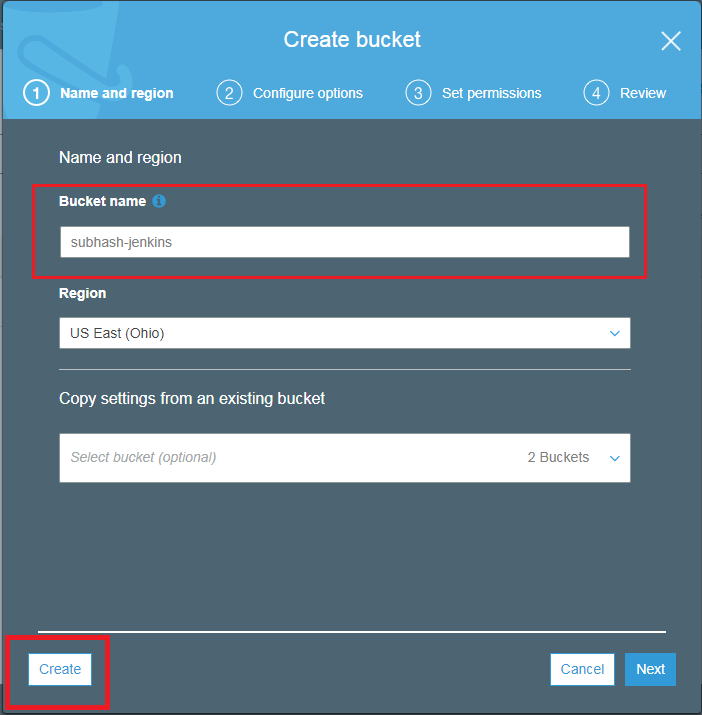
**1. Create a new bucket for Jenkins in AWS S3**\
\
[](https://1.bp.blogspot.com/-4KFxYBgHkrU/W2K4s5mMkWI/AAAAAAAAIeQ/BhCfwxie9_olq5Lcjbp09FrvF31sy7xbwCLcBGAs/s1600/7.PNG)\
**2. Install S3 Plugin in Jenkins**\
\
Now go to **Dashboard** -> **Manage Jenkins** -> **Manage Plugins** and select \
**Available** tab. Find **"S3 plugin"** and install it.

\
**3.** Go to **Manage Jenkins** and select **Configure System**. look for **Amazon S3 Profiles**.


\
\
Click on **Add** button for add S3 profile.\
\
**4.** Please provide a **profile name, access key** and **secret access key** for your AWS account. also, Create an **IAM user** with the relevant **S3 Permissions**.
\
Click on **Save** button.\
\
**5. Configure in Jenkins Job**\
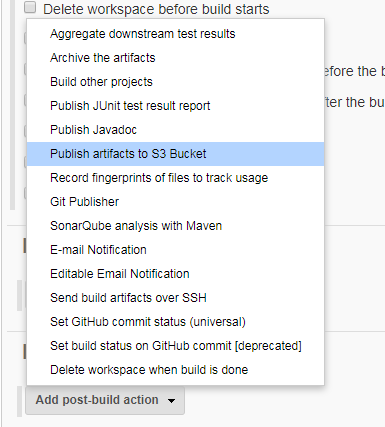
Go to Jenkins job and find **Post Build Actions** and add a new **Post Build Action** and select **Publish Artifacts to S3 Bucket.**\
\
\
[](https://4.bp.blogspot.com/-mEMpC6SuTSk/W2K7V8C8xJI/AAAAAAAAIe0/gIp4-nzvGj0UMpp8WXnwMgA2ddszUHBQgCLcBGAs/s1600/4.PNG)\
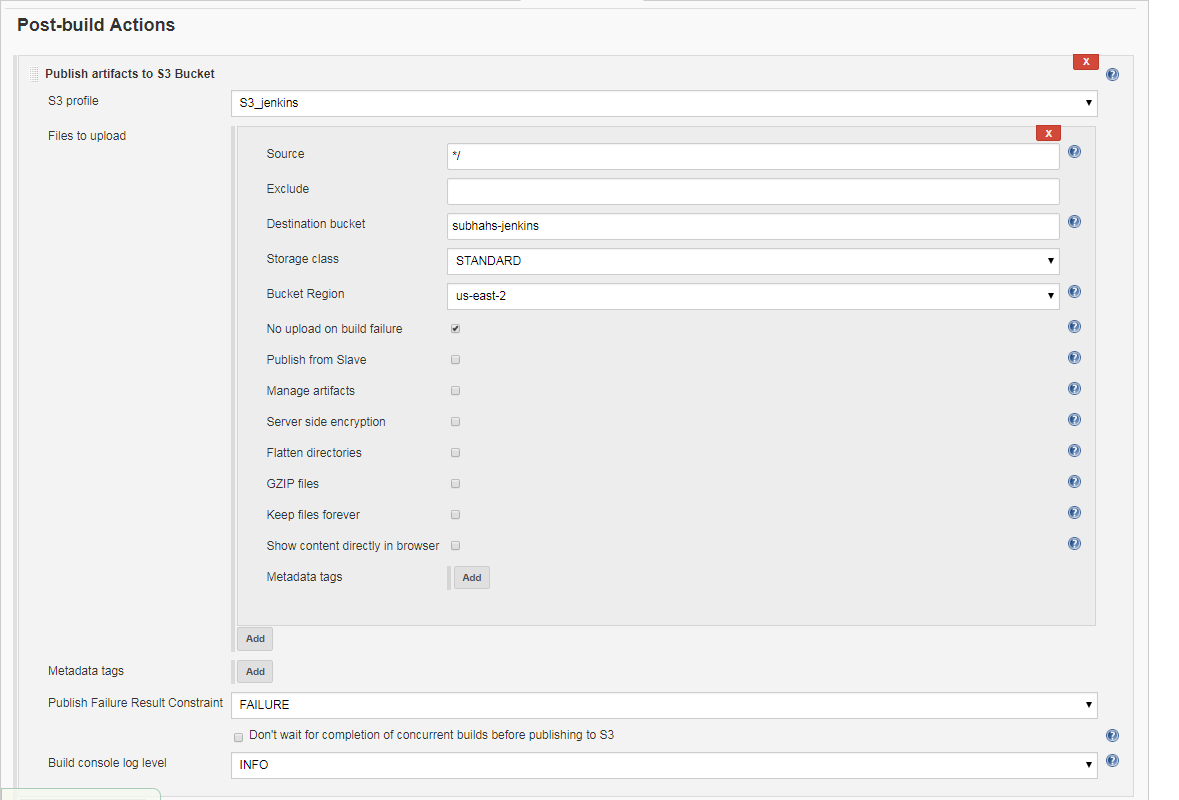
**6. Configure your S3 Profile and define the files to upload.**\
[](https://4.bp.blogspot.com/-j-t1eGBMJ7Y/W2K7h0gEwJI/AAAAAAAAIe4/CsnRUrJGDCIqCjp0LE7HyvBiMw_YwWDjACLcBGAs/s1600/5.PNG) \
Click on **Save** button.\
\
Now each time you run a (successful) build, your artifacts will automatically upload to your S3 bucket.